
✦
Pearls & Pitfalls
Quick practical surgical and clinical lessons.
ISMAIL STRABISMUS ACADEMY
Clinical, surgical and educational resources in strabismus.
Surgical techniques, reoperations, operative pearls and pitfalls.
Clinical photographs, surgical images, diagnostic signs and selected cases.
Surgical and educational video library.
Interesting and challenging strabismus cases.
Quick practical surgical and clinical lessons.
LIBRARY · SURGICAL
Surgical Tip · YouTube Short
LIBRARY
Educational Video · YouTube
Online Webinar · English · YouTube
محاضرة باللغة العربية · YouTube
محاضرة باللغة العربية · YouTube
CLINICAL CASE LIBRARY
A 63-year-old man with type 2 diabetes and hypertension noticed horizontal double vision on waking, worse when looking at the television and when turning to the right. He had a dull ache above the right eye for two days before. He had no other symptoms.
Acuity 6/6 in each eye; pupils equal and reactive; no ptosis; normal fundi without disc swelling. Esotropia 18 PD at distance and 8 PD at near, increasing to 30 PD in right gaze and 6 PD in left gaze. Right abduction −2 with slowed abducting saccades. Facial sensation, facial movement, and hearing normal. No other neurological signs. Blood pressure 162/94.
An acute, isolated, painful-onset abduction deficit in an older patient with vascular risk factors is most likely microvascular. Pain in the first days does not exclude it. However, giant cell arteritis must be screened for, and a minority of such palsies prove to have another cause.
ESR 14 mm/h, CRP normal, platelets normal; HbA1c 8.4%. MRI brain with contrast, including the skull base and cavernous sinus, was normal.
8 weeks: deviation fell to 6 PD at distance and abduction was −0.5.
12 weeks: orthophoric with full abduction and normal saccades.
CLINICAL CASE LIBRARY
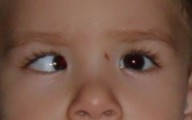
A 14-month-old girl had had a large inward turn since she was about 3 months old, confirmed in photographs.
Constant esotropia 45 PD at distance and near, comitant; cross-fixation; full abduction on doll's head manoeuvre and after brief occlusion of each eye; free alternation. No nystagmus. Cycloplegic refraction +1.00 in each eye. Normal fundi and development.
Onset before 6 months, a large constant angle, cross-fixation, full ductions on the doll's head test, and low hypermetropia indicate infantile esotropia. There is no accommodative component to treat and no amblyopia because she alternates.
Esophoria 4 PD at one year, with gross stereopsis and peripheral fusion (monofixation).